Central Coast Homeowners Are
Quietly Fighting Back
Against Rising PG&E Bills
California power prices surged 96%. Now the question is simple:
how many more years are you willing to just keep paying it?
Dear Central Coast homeowner,
PG&E won't say it. So we will.
You're getting f***ed.
You have approximately 7,000 things competing for your money right now.
Groceries. Gas. Insurance. Subscriptions you forgot you had. That random “service fee” that somehow shows up everywhere now.
And then… just when your bank account is already limping into the end of the month…
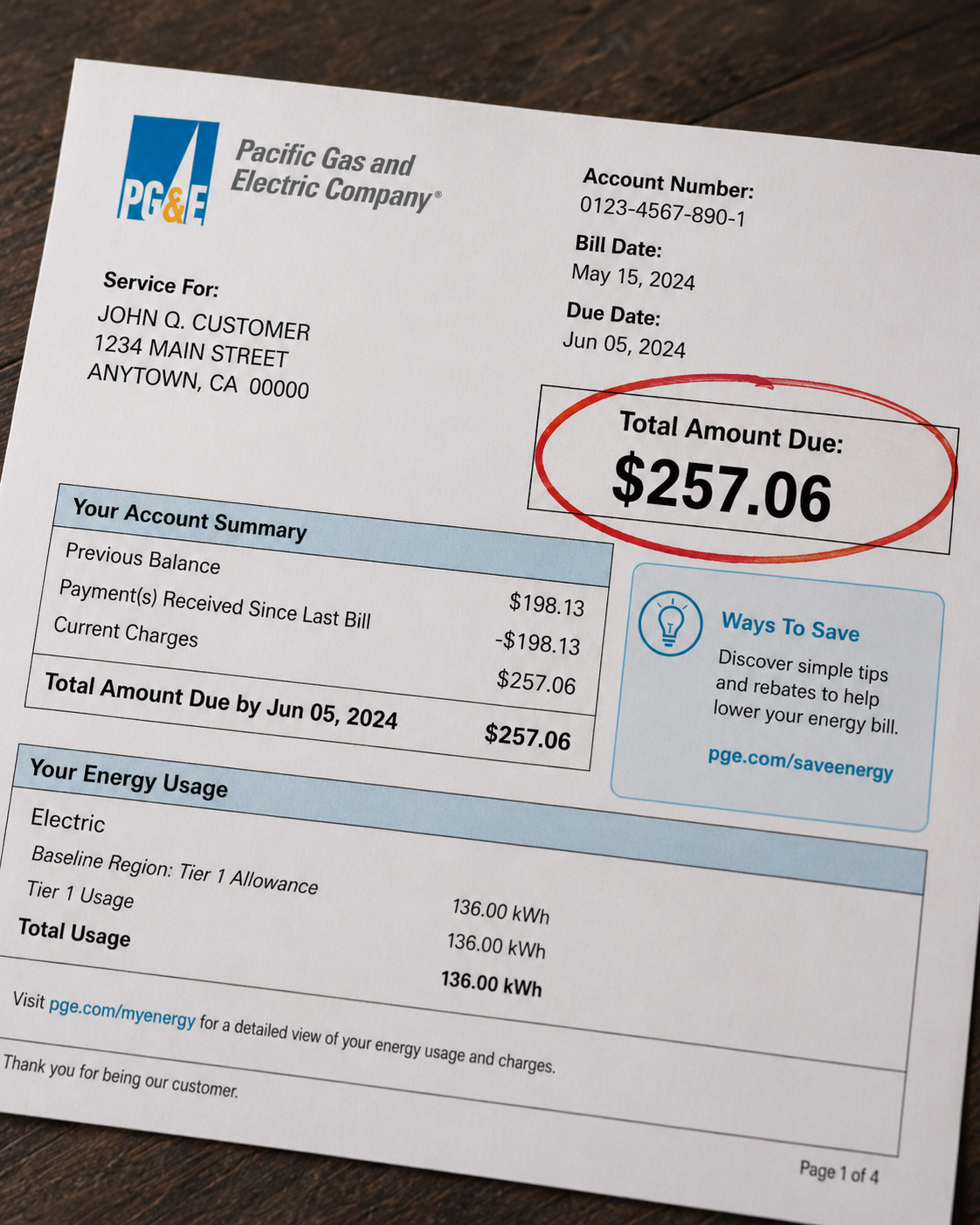
Here comes the PG&E bill. Again.

Bigger than it should be. More annoying than it has any right to be. And somehow completely unavoidable.
Because what are you supposed to do? Stop using electricity? Light candles? Cook dinner over a campfire in the backyard? Please.
You pay it. You complain about it. You cut back somewhere else. Then next month, the whole ugly little ritual starts over again. Pay it. Complain. Repeat.
It's not exactly a financial strategy. It's more like getting mugged in slow motion by your own utility bill.
And the worst part? You're probably starting to get used to it.
Especially when California electricity prices surged 96% from 2014 to 2024. Nearly double.
They're robbing you and calling it a rate increase.
Remember when gas was a dollar a gallon?
Nobody at the pump back then thought they'd hand over six bucks a gallon someday. But it crept. A nickel here. A dime there. Until one day you're standing at the pump doing a double take.
Your power bill is running the exact same play. Small increases, every year, quietly compounding into a number you never agreed to.
That $200 bill you grumble about today? At the rate PG&E is going, it becomes nearly $1,400 a month in 25 years.
Same house. Same family. A bill that quietly tripled while you weren't looking.
Add it all up and you don't spend $200 a month. You hand PG&E six figures over 25 years — and own nothing. Not a panel. Not a wire. Not a single watt.
You're renting your power. And the rent goes up every year. Forever.
Illustration based on a typical $200/mo PG&E bill rising at its historical pace. Your real numbers come from the calculator. Future utility rates vary.
So here's the good news.
You're not actually stuck. You just haven't been shown the way out.
Solar's whole job is dead simple: it locks your rate while everyone else's keeps climbing.
Now, normally this is where a solar company sends a guy to your door. He parks at your kitchen table for two hours. He “just needs to show you a few things.” He won't leave until you sign — or until you walk him out yourself.
I think that's a lousy way to treat people.
So I did the opposite. (I'm Pat, by the way — I install solar here on the Central Coast.) I built a calculator.
You give it three things: your bill, your address, and where to send the results. It pulls your actual roof from Google's satellite data, reads your actual PG&E rate, and shows you what solar would really save your specific home.
No salesman. No doorstep visit. Just your real numbers, in your inbox in about five minutes.

Because this was never really about panels.
It's about not being at PG&E's mercy for the rest of your life. It's about locking your bill while your neighbors' keeps climbing. It's about keeping your lights on when the grid goes down — like it did in 2020.
It's about the money, the peace of mind, and finally stopping the slow-motion mugging.
You don't have to decide anything today. Just find out where you stand.

Alright — let's see
your numbers.
Your real roof, your real PG&E bill, your real numbers. About 2 minutes. Free. No salesman.
Solar is designed for homeowners
Solar financing requires property ownership. Know a homeowner in Santa Barbara or SLO County? Feel free to share this page with them.
Built on Google's satellite data
not back-of-the-envelope math.
Most "solar savings calculators" use generic averages. Ours uses Google's Solar API — the same satellite imagery and 3D modeling Google built to map every roof in America.
- Real solar potential, calculated from your roof's exact angle, orientation, and shading
- Your actual PG&E rate, not a national average
- Accurate to within ~10% of post-installation actual savings
These neighbors ran the calculator.
Here's what they found.
Most weren't sure solar made sense for their home — until the numbers came back.
The grid wasn't built
for what's coming.
Every year, more gets plugged into the same power grid — one largely built decades ago, long before any of this existed.
AI and the internet are spawning data centers nationwide — a single one can draw as much electricity as a small city.
Millions of EVs now plug in every night, all pulling from the same aging lines.
Heating, cooling, appliances — entire homes are moving onto the grid at once.
More demand. More strain. On infrastructure that was already stretched thin.
And here on the Central Coast, the weather stopped being predictable.
Wildfire seasons that start earlier and burn hotter. Wind events. Atmospheric rivers, floods, and the debris flows that follow. And PG&E shutting your power off on purpose — sometimes for days — just to keep its own lines from sparking the next fire.
Every year, it leaves thousands of homes across our area sitting in the dark.
When it happens, the fridge goes warm. The Wi-Fi dies. The house goes quiet and cold. And you wait — with everyone else — on a utility that already proved it can't keep up.
Here's the part nobody puts on a billboard:
Solar by itself shuts off in an outage. Solar paired with a home battery doesn't.
When the grid goes down, your home keeps running on the power your own roof made. Lights on. Fridge cold. Phones charged. Your family safe inside — instead of riding out another blackout in the dark.
That's not just a smaller bill. It's not being at anyone's mercy — not PG&E's, not the weather's, not whatever gets plugged in next.
It's protection you own. And from here, it only gets more valuable.
Worst case, you waste two minutes.
Best case, you save six figures.
The calculator is free, there's no salesman, and you're under zero obligation. The only thing you're risking is finding out you waited too long.